Trauma Survivors Network
Post-Trauma LifeResource ConversationsSupport and CaregivingYou Are Not Alone

Finding Support After Traumatic Injury

You Don’t Have to Recover Alone

One of the biggest misconceptions about traumatic injury is that once someone leaves the hospital, they are “back to normal.”

For many survivors and their loved ones, discharge is not the end of the journey—it’s the beginning.

The physical healing process often comes with appointments, rehabilitation plans, and follow-up care. But the emotional and mental recovery that follows an injury can be much harder to navigate. Survivors may feel isolated, overwhelmed, anxious, frustrated, or unsure how to adapt to a life that suddenly looks different than it did before.

Family members and caregivers often face their own challenges as they support someone they love while processing their own trauma and stress.

The good news is that no one has to walk that journey alone.

The Importance of Connection After Trauma

The American Trauma Society (ATS) works to improve trauma care at every level—from first responders and healthcare professionals to survivors and families. One of the ways they do this is through the Trauma Survivors Network (TSN), a program designed to provide support, community, education, and connection for people impacted by serious physical injuries.

Traumatic injuries can leave people feeling like no one truly understands what they are experiencing. While friends and family may want to help, they may not know what to say or how to provide support.

Connecting with others who have experienced similar challenges can make a significant difference.

Sometimes the most powerful thing a survivor can hear is:

“I’ve been where you are, and there is life after this.”

Seeing someone who has adapted, rebuilt, and found a new path forward can offer hope during a difficult season.

Adapting to a New Reality

Recovery often involves more than healing physically. It may require adapting to changes in mobility, routines, relationships, work, hobbies, or expectations.

Many survivors describe this process as learning how to navigate a “new normal.”

That adaptation can feel overwhelming when you’re trying to figure it out on your own. Connecting with other survivors and caregivers allows people to learn from those who have already faced similar challenges and discovered ways to move forward.

The goal is not to return to who you were before the injury.

The goal is to learn how to live well within your current reality.

The Power of Peer Support

One of the foundations of trauma recovery support is peer connection.

Many trauma centers throughout the Trauma Survivors Network offer peer visitation programs where trained volunteers—often survivors themselves or caregivers who have walked a similar path—visit patients during their hospital stay.

These visits provide more than information.

They provide hope.
When someone sees a survivor who has faced a similar injury and is now living a meaningful life, it can create a powerful mindset shift. It reminds them that recovery is possible and that their story is still being written.

Support Groups for Survivors and Families

Support groups offer another opportunity to connect with people who understand.

The Trauma Survivors Network hosts several virtual support groups each month and also maintains a directory of local support groups throughout its network. Groups are available for a variety of populations, including:

  • Adult survivors
  • Caregivers and family members
  • Teens and young adults
  • Pediatric injury families

Every support group is a little different, but they all share a common purpose: creating a safe space where people can listen, share, ask questions, and learn from one another.

Participation is flexible. Some people feel ready to share their experiences. Others may prefer to simply listen and learn.

Both are welcome.

The important thing is knowing that support is available when you’re ready.

Finding Resources in Your Community

The Trauma Survivors Network includes more than 300 trauma centers across the United States, Canada, and Australia and provides resources to individuals seeking support from anywhere in the world.

One of the most valuable features available through the network is the ability to search for support close to home.

Visitors can use the TSN website’s map or search function to find participating trauma centers, support groups, educational programs, and local resources available in their area.

Joining a local TSN center can help survivors and families stay informed about support opportunities, educational events, and recovery resources available within their own community.

Resources Beyond Support Groups

In addition to support groups and peer mentoring, the Trauma Survivors Network offers a variety of educational resources designed to help survivors and caregivers navigate recovery.

Resources include:

  • Survivor stories and recovery journeys
  • Educational guides and resource directories
  • The TSN Notebook, a collection of tools and information for recovery
  • Community-led resources developed by survivors for survivors

The network also maintains active social media communities that provide ongoing encouragement, education, and opportunities for engagement.

Programs include:

  • Toolkit Tuesdays, featuring questions and solutions shared by the community
  • Family Fridays, focused on caregiver support and resources
  • Monthly Injury Insights, where survivors answer anonymously submitted questions about recovery

These initiatives help create ongoing opportunities for connection and learning long after someone leaves the hospital.

Recognizing Trauma Survivors

Each May, communities across the country observe National Trauma Awareness Month.

During this month, the Trauma Survivors Network also celebrates National Trauma Survivors Day on the third Wednesday of May.

Events held throughout the country honor survivors, caregivers, first responders, healthcare teams, therapists, home health professionals, and everyone involved in the recovery journey.

These celebrations help raise awareness about the realities of life after injury while recognizing the resilience of those who continue moving forward.

If You’re Struggling, You’re Not Alone

Sometimes people don’t immediately recognize that they need support.

Instead, they may notice they are more emotional than usual. More anxious. More withdrawn. More frustrated. Less interested in things they once enjoyed.

These changes can be signs that the emotional impact of an injury is still unfolding.

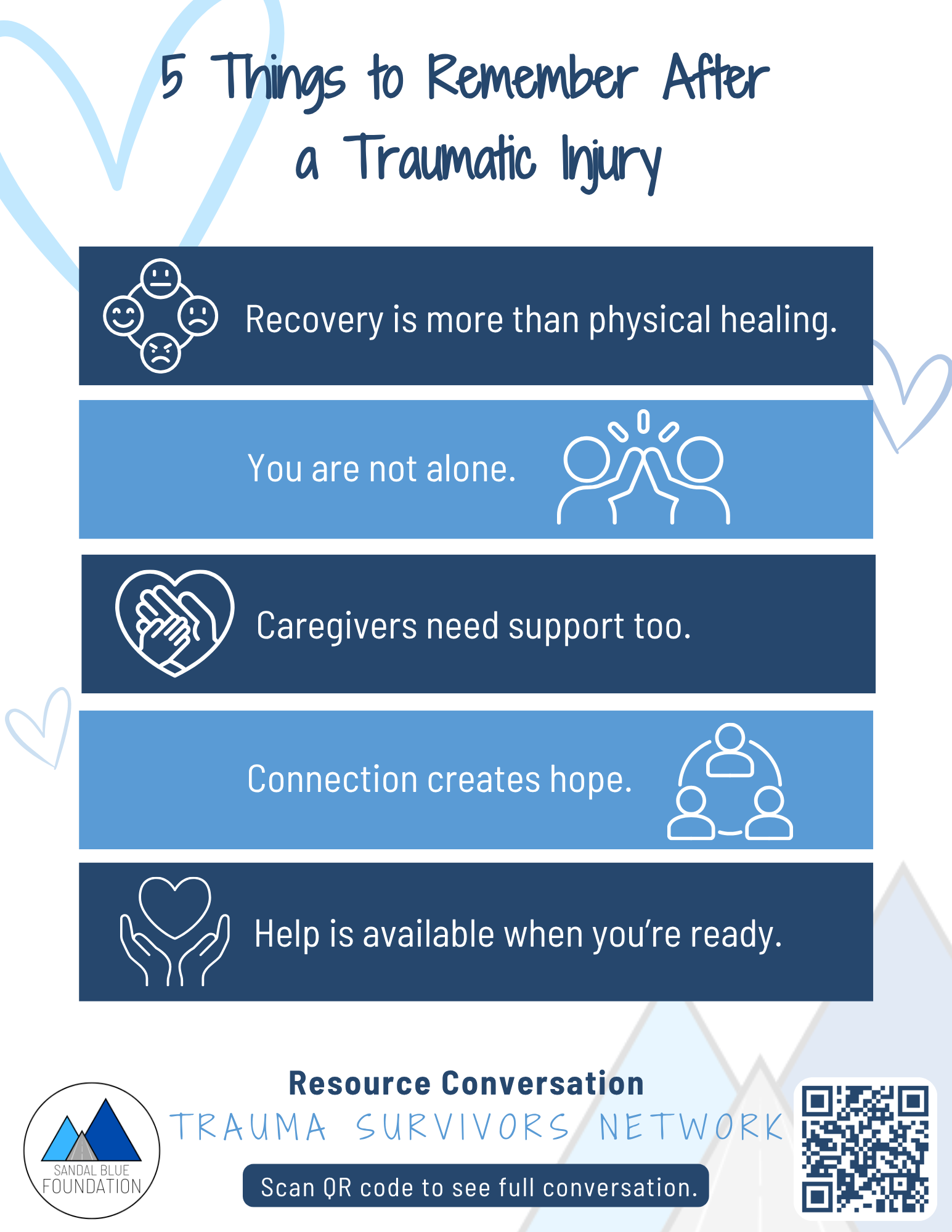
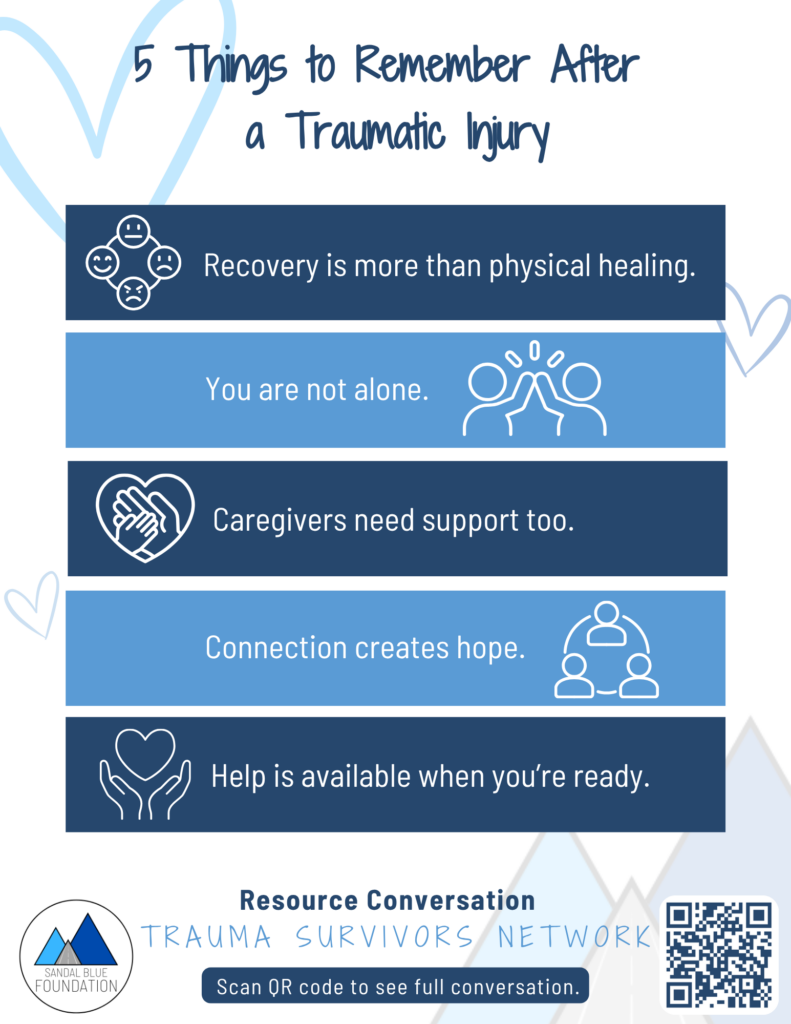
Recovery is not only physical.

It’s emotional, mental, social, and relational as well.

Whether you’re a survivor, caregiver, family member, or friend, support is available.

You don’t need to have all the answers before reaching out.

You don’t even need to share your story if you’re not ready.

You can simply listen, explore resources, and connect when the time feels right.

Because no one should have to navigate recovery alone.

Watch the Full Resource Conversation

Want to learn more about the resources, support programs, and survivor connections available through the Trauma Survivors Network?

Watch our full conversation with Abby Beerman, National Trauma Survivors Network Coordinator, as we discuss life after traumatic injury, the importance of peer support, resources for survivors and caregivers, and how to find help in your community.

Whether you’re a survivor, caregiver, family member, or healthcare professional, this conversation offers valuable insight into the recovery journey and the reminder that no one has to navigate it alone.

Learn More

To explore resources, find support groups, locate a Trauma Survivors Network center near you, or learn more about available programs, visit:

www.TraumaSurvivorsNetwork.org

The website offers a searchable directory of trauma centers, educational resources, survivor tools, and opportunities to connect with others who understand the journey of recovery after injury.

Window of Tolerance
Post-Trauma LifeResource Conversations

Understanding Your Window of Tolerance After Trauma

There are moments after trauma when it feels like you are not reacting like yourself.

You are more irritable than usual.
More emotional.
More disconnected.
More exhausted.
More overwhelmed by things that once felt manageable.

And sometimes, the opposite happens.

You stop reacting altogether.

You scroll your phone for hours.
You feel numb.
You disconnect from people.
You move through the day checked out and unfocused, content to let life pass by because engaging with it feels too hard.

According to Keri Jones-Fonnesbeck, Executive Director of Trauma-Informed Utah, both of these experiences are part of being human — especially after trauma.

And understanding them begins with something called the Window of Tolerance.

What Is the Window of Tolerance?

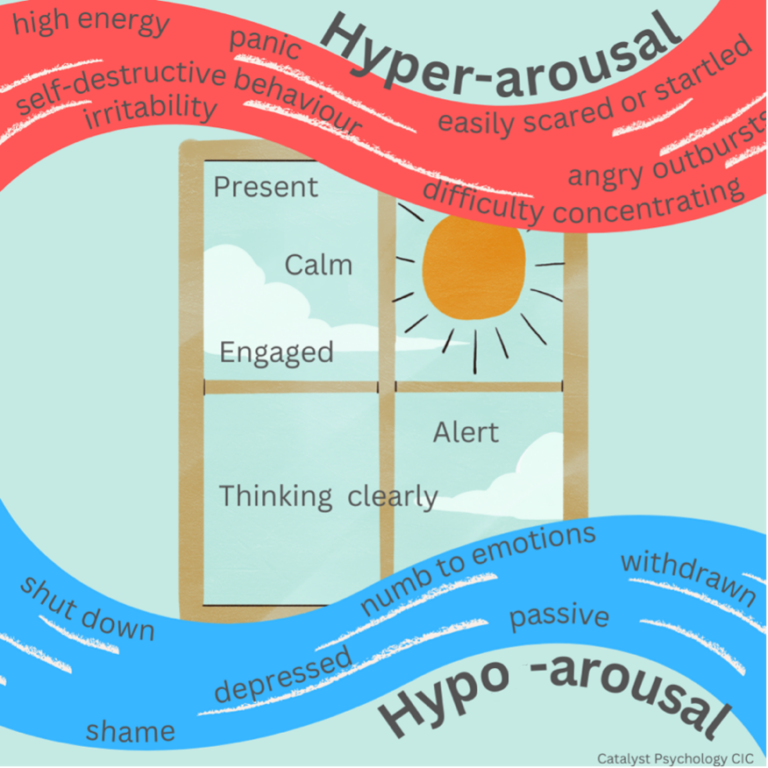
Keri describes the window of tolerance like looking through a clear window.

Inside the window, you are calm, connected, and present.

You can think clearly.
Regulate emotions.
Communicate effectively.
Engage in meaningful conversations.
Show up as your best self.

You have the clearest view of both yourself and the world around you.

But trauma impacts the brain and nervous system. It changes how we regulate emotions, connect with others, and respond to stress. Sometimes we get “kicked out” of that window.

And that is normal.

Not because you are failing.
Not because you are weak.
But because you are human.

Click here to learn more about the Window of Tolerance constructed by Dr. Dan Siegel in 1999.

Above the Window: Fight or Flight

Sometimes being outside the window looks loud.

Big emotions.
Frustration.
Anger.
Panic.
Overwhelm.

This is often the nervous system moving into fight or flight.

Sometimes it is triggered by something external — a loud noise, a stressful interaction, a smell, a memory, a feeling — something that reminds the brain of a time when we were not emotionally or physically safe.

Even when we consciously know we are okay, the body responds as though danger is present.

This is why self-awareness matters so much.

Recognizing:

  • What emotions feel biggest for me?
  • What situations tend to trigger them?
  • What signs show up in my body before things escalate?

These are not questions about judgment.

They are questions about awareness.

Below the Window: Freeze and Shutdown

Other times, being outside the window looks quiet.

You feel numb.
Disconnected.
Unfocused.
Emotionally flat.
Checked out.

Keri explains this as the freeze response, or hypoactivation.

This can look like:

  • Endless scrolling
  • Avoiding decisions
  • Feeling detached
  • Not paying attention
  • Losing motivation
  • Feeling like you “don’t care”

When this happens, the goal is not shame.

The goal is noticing.

Because once we notice, we can begin gently supporting ourselves back toward regulation.

Image Source: OC Psychotherapy Centre, “Window of Tolerance”

Your Window Can Shrink — and Expand

One of the most important reminders from Keri is that the window of tolerance is not fixed.

It is more like an accordion.

It can shrink during periods of stress, trauma, exhaustion, grief, illness, or overwhelm.

And it can expand with support, awareness, practice, and care.

The way we care for ourselves matters.

Have I eaten?
Hydrated?
Slept?
Moved my body?
Connected with someone safe?

How we show up for ourselves impacts how we show up for others.

Healthy people create healthy systems.

And trauma-informed care is about building that understanding into every system humans interact with — healthcare, schools, businesses, nonprofits, agencies, and communities.

Finding Your Way Back Into the Window

The goal is not to stay perfectly regulated all day.

None of us do.

We move in and out of our window constantly.

The key is learning:

  • How to notice it
  • How to respond
  • How to return

Keri emphasizes that there is no one-size-fits-all solution.

The most important thing is finding what works for you.

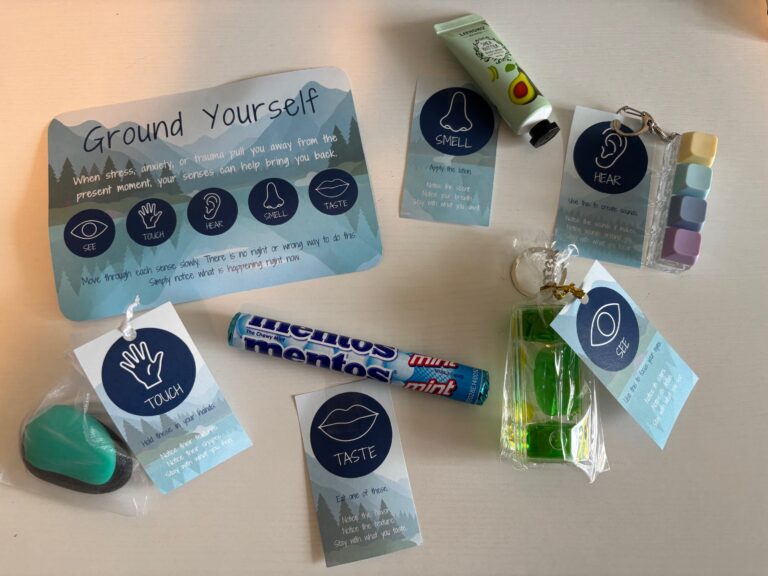
Often, our senses are the pathway back.

The same senses that can trigger us can also help ground us.

Maybe it is:

  • Ocean sounds
  • Essential oils
  • Deep breathing
  • A drink of cold water
  • Going on a walk
  • Looking at pictures of people you love
  • Calling someone safe
  • Moving your body
  • Squeezing your muscles to create blood flow

The goal is simple:
To remind your nervous system:

I am here.
I am safe.
I am well.
I am okay.

The 5-4-3-2-1 Grounding Exercise

One practical tool Keri shared is the 5-4-3-2-1 grounding exercise.

When you notice yourself outside your window, pause and identify:

  • 5 things you can see
  • 4 things you can touch
  • 3 things you can hear
  • 2 things you can taste
  • 1 thing you can smell

Say them out loud if possible.

The purpose is not perfection.

It is presence.

It is bringing your awareness back into your body and into the current moment.

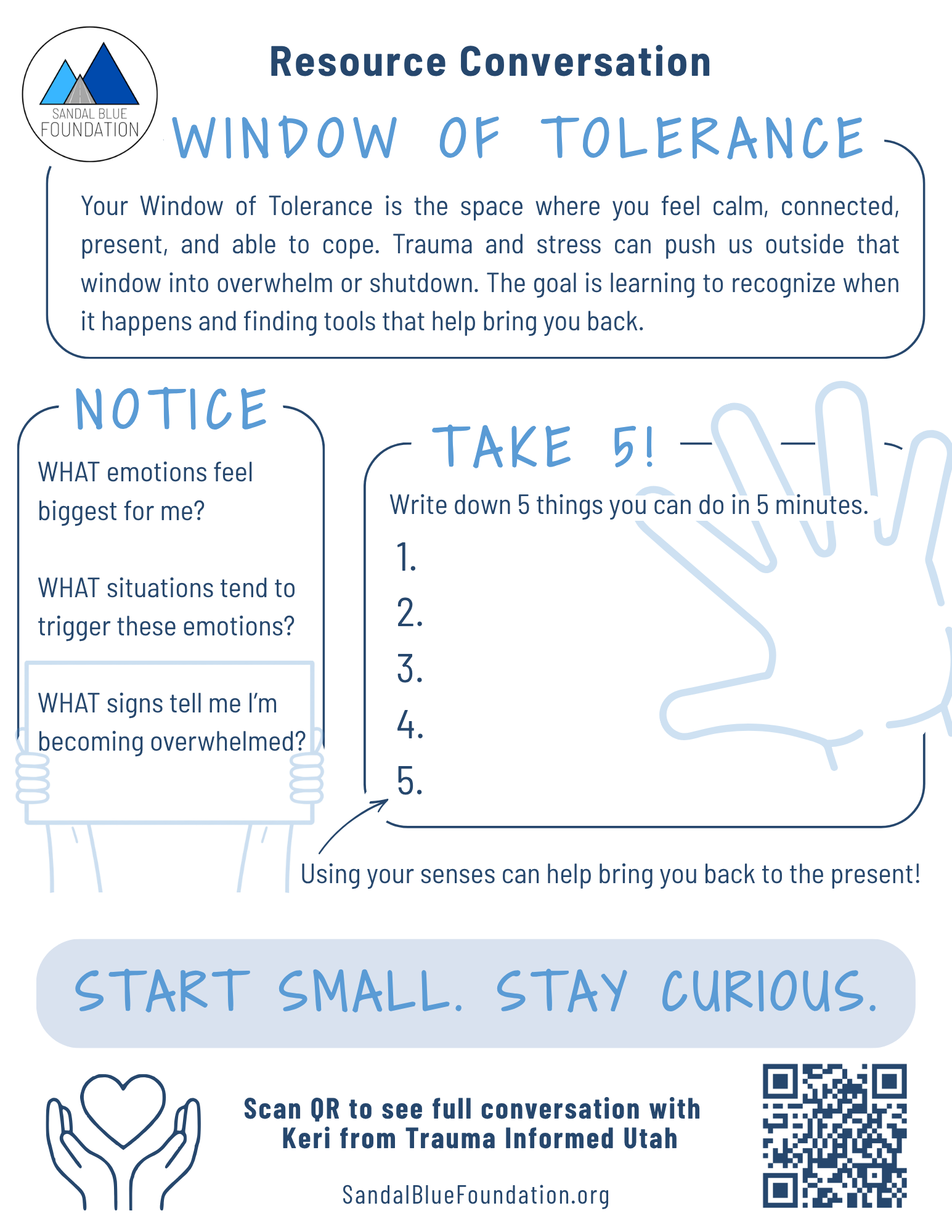
The “Take 5” Plan

Keri also encourages people to create a simple “Take 5” plan ahead of time.

Start with these questions:

  1. What emotions are most difficult for me?
  2. What situations tend to trigger those emotions?
  3. What signs tell me those emotions are starting to become too big?

Then create a list of five things you can do in five minutes that help calm and regulate your nervous system.

Examples might include:

  1. Looking at pictures of your kids
  2. Taking deep breaths
  3. Listening to ocean sounds
  4. Drinking a Diet Coke
  5. Calling someone you trust

Simple matters.

Small matters.

The point is not creating a perfect wellness plan.

The point is creating a realistic one.

Presence and Patience

Keri referenced the work of Kristen Neff and the idea that self-compassion requires action.

Not just acknowledging that things are hard.
But responding to yourself with care.

Asking:

  • What do I need right now?
  • What would help me feel supported?
  • What would help me feel present?

And then practicing those things consistently.

Not perfectly.
Just consistently.

Because healing is a practice.

You Don’t Have to Do It Alone

One of the most powerful suggestions Keri shared was to involve another person.

Write down your answers.
Share your Take 5 plan with someone you trust.
Ask them to check in with you.

“This is something I’m trying for myself. Can you check in with me this week?”

Sometimes support looks incredibly simple.

And incredibly powerful.

A Reminder for Trauma Survivors

If you are struggling to stay regulated after trauma, it does not mean you are broken.

It means your nervous system has been through something significant.

Awareness matters.
Support matters.
Practice matters.

And so does patience with yourself.

As Keri shared during our conversation:

“You are a gift to you, and we’re so glad that you’re still here.”

Learn more about Trauma-Informed Utah at traumainformedutah.org.

Watch this incredible Resource Conversation with Keri Jones-Fonnesbeck from Trauma Informed Utah

Universe Juice
Post-Trauma LifeResource Conversations

Reuniting Survivors and First Responders Through Universe Juice

After a traumatic motor vehicle incident, there are often people who become part of your story without ever truly becoming part of your life.

The paramedic who held your hand.
The firefighter who cut open the vehicle.
The nurse who stayed beside you in the trauma bay.
The dispatcher who answered the call.

For many survivors and families, those individuals remain unknown — even though they were present during some of the most critical moments of their lives.

Universe Juice exists to change that.

Founded by trauma survivor Lisa Brunetti, Universe Juice is a nonprofit organization devoted to reconnecting survivors and their families with the first responders who cared for them during traumatic incidents. The organization was inspired by Lisa’s own experience after surviving a severe head-on collision with a drunk driver in 2022.

After later meeting some of the first responders involved in her rescue and transport from Boston MedFlight to a Level One Trauma Center, she experienced firsthand how emotional and healing those reunions could be — not only for survivors, but for the responders as well.

For survivors, reunions can offer gratitude, closure, healing, and the opportunity to reconnect pieces of a story that may feel incomplete.

For first responders, it can be one of the rare opportunities to see the outcome of the lives they fought so hard to protect.

How the Reunion Process Works

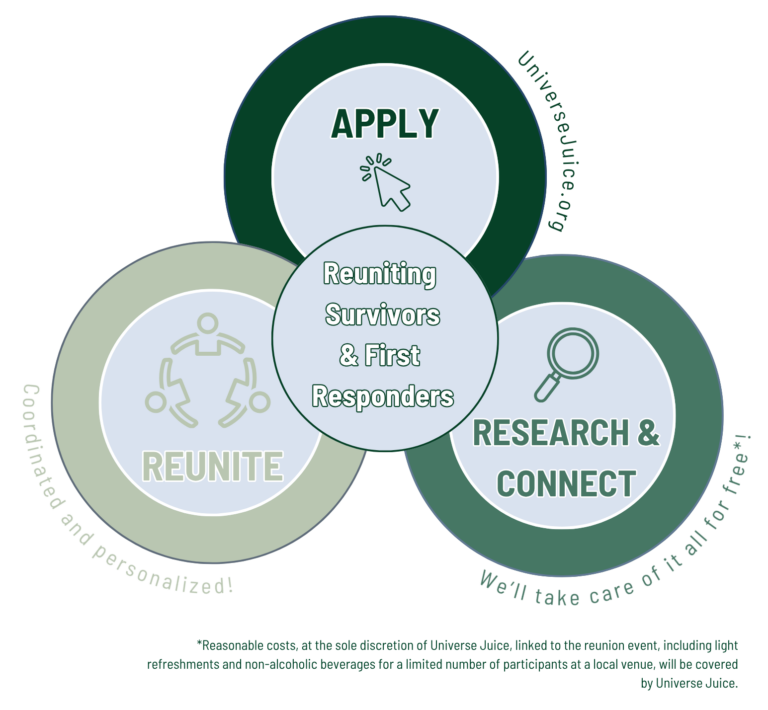
Universe Juice has created a simple application process for survivors and families interested in reconnecting with responders involved in an incident.

Applications can be completed directly on the Universe Juice website, and individuals are encouraged to include as much information about the incident as possible, including:

  • Date and time of the incident
  • Location
  • Police or accident reports if available
  • Any remembered details about responding agencies, hospitals, or emergency personnel

Applicants do not need to have every detail organized before starting. Even limited information can help begin the process.

Applications can be submitted by survivors themselves or by someone applying on their behalf.  For survivors 17 years of age or younger, the application must be placed by a (custodial) parent or legal guardian.

One important aspect of the organization’s work is that there is no time limit on healing.

Reunions may happen shortly after an incident, years later, or even decades later.

Once an application is received, Universe Juice begins researching the incident to identify which agencies and responders were involved. The organization reaches out to department leaders and teams to determine who may be willing and available to participate in a reunion.

Everything about the process is voluntary and centered around the comfort levels of everyone involved.

Image curtesy of Universe Juice

Creating a Comfortable and Healing Experience

Every reunion is personalized based on what feels most meaningful and supportive to those participating.

Some reunions happen at fire stations. Others take place at hospitals, restaurants, or private locations. Some survivors prefer to know exactly who will attend beforehand, while others choose to keep the experience a surprise.

Universe Juice works with both sides to create a comfortable, personal, and supportive environment.

The organization also recognizes that reunions involving trauma can bring up intense emotions. Protocols are in place to support emotional well-being during reunions, including crisis support team members onsite if needed and private spaces available for anyone who may need a quiet moment.

These reunions are not limited only to incidents where everyone survived.

Families who lost loved ones may also choose to reconnect with first responders as part of their healing process. In many cases, those conversations can provide answers, gratitude, connection, and closure that remain meaningful years later.

Universe Juice
Photo curtesy of Universe Juice

Removing the Burden from Survivors

While some survivors may attempt to locate responders on their own, the process can quickly become overwhelming.

Tracking agencies, locating personnel, coordinating schedules, and organizing communication takes time and emotional energy that many survivors and families simply do not have.

Universe Juice removes that burden.

The organization handles the research, outreach, coordination, and planning involved in creating the reunion experience, allowing survivors and families to focus on healing rather than logistics.

There is no cost for the investigation, reunion planning, and coordination of reunions.  Reasonable costs, at the discretion of Universe Juice, for refreshments provided during reunions will be covered free of charge. If extensive travel or flights are involved, those expenses may need to be covered separately by participants. Alcohol is not covered.

Currently, the only geographic requirement is that the original incident occurred within the United States.

A Different Kind of Healing

Healing after trauma does not always come through surgeries, therapies, or time alone.

Sometimes healing comes through connection.
Through gratitude.
Through finally meeting the people who carried you through the hardest day of your life.

Universe Juice was built by someone who has lived that experience personally and understands the emotional impact these reunions can have on everyone involved.

To learn more, begin an application, or follow reunion stories, visit:
https://www.universejuice.org/ 

Follow on social media:
@UniverseJuiceInc

This is Just the Beginning

This conversation highlights something many trauma survivors and first responders quietly carry for years: unanswered questions, unfinished moments, and people connected by tragedy who never had the opportunity to reconnect.

Universe Juice is creating space for those reunions to happen with care, compassion, and intention.

We are grateful for the work Lisa Brunetti and the Universe Juice team are doing to bring healing, closure, and human connection to both survivors and the first responders who walked through those critical moments beside them.

A sincere thank you to Universe Juice for sponsoring this episode and sharing their mission and helping create meaningful pathways toward healing after trauma.

Resource Conversation YouTube Thumbnails
Post-Trauma LifeResource ConversationsSupport and CaregivingYou Are Not Alone

Personalized Recovery Support After Trauma

Resource Conversation with Matt Kalina from TandemStride

Recovery doesn’t end at discharge.

For many survivors and caregivers, that moment—leaving the hospital—is where a new kind of uncertainty begins. There’s often relief, but also hesitation, fear, and a very real question: what happens now?

This resource conversation with Matt Kalina from TandemStride focuses on that exact transition point, and how personalized, trauma-informed support can help people feel less alone in it.

These conversations are designed to give motor vehicle incident survivors and their caregivers practical tools, guidance, and support as they move through recovery—especially in the spaces where systems often fall short.

A Personal Beginning to the Work

Matt’s connection to this work is deeply personal.

His brother was involved in a pedestrian train accident 14 years ago and became a bilateral amputee at age 23. That experience shaped Matt’s understanding of what recovery can feel like when there is no roadmap—when you are trying to rebuild your life while also trying to understand what that life will even look like.

Later, after a decade of building healthcare technology, Matt kept seeing the same gap repeat itself: even with advances in medicine and systems, trauma survivors were still often left feeling alone after discharge, without clear guidance or connection.

TandemStride was built from that gap.

The Space After the Hospital

One of the most consistent challenges in trauma recovery is the transition from acute care to home.

Hospital discharge is often treated as an endpoint, but for survivors and caregivers, it can feel like the beginning of the hardest part. There is often hesitation, resistance, and uncertainty about what recovery actually looks like day to day.

TandemStride was designed to support that exact transition—helping people move from structured hospital care back into everyday life with more guidance, connection, and support.

The platform is used primarily by survivors with physical traumatic injuries such as spinal cord injuries, amputations, polytrauma, major fractures, burns, gunshot wounds, and violent crimes. Most users join within 7–14 days of discharge, though support is available at any point in recovery.

A Different Kind of Recovery Support

At the core of TandemStride is a simple idea: recovery shouldn’t be something you navigate alone.

The platform uses insights from thousands of trauma survivor journeys to better understand when challenges typically arise—such as mental health changes, substance use risk, or other barriers that can show up later in recovery.

Instead of waiting for those challenges to become crises, TandemStride works to identify patterns early and offer support proactively.

That includes:

  • Connecting survivors with peer mentors (often matched by injury type or age at injury)
  • Helping users find local resources through guided navigation
  • Offering caregiver and survivor-facing tools inside a single platform
  • Supporting both passive and active engagement, depending on what feels manageable

Get the App

TandemStride is available on the App Store and Google Play.

It is free to download and use, with some features varying depending on regional partnerships or programs (such as certain state-based initiatives).

Meeting People Where They Are

When users first open the TandemStride app, they are met with a simple question: What is your biggest challenge right now?

From there, the experience is personalized. The app guides users toward resources based on what they need most in that moment, rather than forcing them through a one-size-fits-all system.

This “choose your own adventure” approach allows survivors to engage in a way that feels right for them—whether that’s actively exploring resources or simply having support available in the background.

Community, Connection, and Not Feeling Alone

A major focus of TandemStride is building connections between survivors who understand what each other is going through.

On May 20th, 2026 – the platform is launching a new Communities feature designed specifically for trauma survivors.

Inside these communities, users can:

  • Check in daily or share updates and milestones
  • Connect with others going through similar experiences
  • Engage through likes, comments, or quiet observation
  • Use AI-supported tools to find local resources
  • Complete optional mental health screeners with guidance

Importantly, users can choose how they engage—there is no pressure to share more than they want to.

Trauma-Informed by Design

A key part of TandemStride’s approach is making sure the platform is safe and adaptable for people in different stages of recovery.

That includes features such as:

  • Content moderation to reduce exposure to triggering material
  • Options to label posts as “high intensity,” with user-controlled viewing
  • The ability to share without receiving advice or feedback
  • Topic filtering so users can control what they see

This design acknowledges something important: recovery is not just physical. Emotional safety matters too.

Small Steps Forward

TandemStride also includes a milestones feature that visually reflects progress over time.

As users engage, their milestone image gradually fills in—starting blank and slowly becoming more complete. It’s a simple but meaningful way to reflect growth, effort, and consistency in recovery.

It also serves as a reminder that progress is often made in small, quiet steps—not just big moments.

A Platform Built by Survivors, for Survivors

At its core, TandemStride is built around lived experience.

It is not just a technology platform—it is an attempt to create something that understands what it feels like to go through a life-altering injury and try to rebuild from there.

The intention is not to replace care teams or support systems, but to extend them—especially into the space where people often feel the most alone.

Why Social Support is Important in Trauma Recovery

A Closing Note

This conversation highlights something that is often overlooked in trauma recovery: the space between hospital and home matters just as much as what happens inside the hospital.

We are grateful to Matt Kalina and the TandemStride team for the work they are doing to bring more structure, connection, and humanity into that space.

A sincere thank you to TandemStride for sponsoring this episode and supporting efforts to make recovery more accessible and less isolating for survivors and caregivers.

Watch our full resource conversation with Matt Kalina from TandemStride about navigating recovery after traumatic injury, finding support after hospital discharge, and building connection through survivor-centered care.

Patient Advocacy 2
You Are Not Alone

Patient Advocacy in Action

Partnering to Strengthen Voices in Research and Care

Patient advocacy is not a concept—it is a lived necessity.

It is what happens when someone in the middle of a medical crisis tries to understand complex decisions. It is what happens when families are navigating hospital systems they never expected to enter. And it is what happens when lived experience is finally brought into the spaces where health care decisions are made.

At Sandal Blue Foundation, we believe patient advocacy is strongest when it is shared, structured, and community-driven. That is why our partnership with the University of Maryland School of Pharmacy’s PATIENTS Program has been such an important part of our work.

A Shared Mission: Centering the Patient Voice

The PATIENTS Program is a nationally recognized community-academic partnership that works to ensure patients, caregivers, and communities are not just participants in research—but co-creators of it. Their work focuses on building trust, improving communication, and strengthening the way research reflects real lived experience.

At its core, their mission aligns deeply with ours:

  • People closest to the problem should help shape the solution
  • Lived experience is essential data
  • Trust is built through consistency and collaboration
  • Health equity requires intentional engagement

This is patient advocacy in action—not as a service provided, but as a system built together.

Expanding Impact: PATIENTS Going National

One of the most powerful expansions of this work is the PATIENTS Going National initiative, which extends their community-engaged research model beyond Baltimore to communities across the United States.

This initiative is designed to bring patient and community voices into research at a national scale by partnering with groups connected through shared experiences such as chronic illness, disability, mental health, aging, and more.

Rather than treating communities as passive recipients of research, this model recognizes something critical:

Communities are experts in their own lived experience.

Through PATIENTS Going National, those lived experiences are being actively integrated into how research questions are formed, how studies are designed, and how health solutions are developed.

You can learn more about the initiative here: The PATIENTS Program and their national expansion effort.

Why This Matters for Patient Advocacy

Patient advocacy is often thought of as something that happens at the bedside or in a hospital hallway.

But true advocacy also happens upstream—in research design, policy development, and system planning.

When patients are included early in the process, everything changes:

  • Research becomes more relevant to real-life needs
  • Communication becomes clearer and more respectful
  • Barriers to care are identified sooner
  • Solutions are shaped by lived experience, not assumptions

This shift is what makes partnerships like ours with the PATIENTS Program so meaningful. It moves advocacy from reaction to co-creation.

What We See in Practice

Through this collaboration, we see a consistent truth:

When people are given space to share their lived experience—and when that experience is taken seriously—systems begin to change.

We see:

  • Caregivers who finally feel heard in clinical conversations
  • Survivors whose experiences help shape research priorities
  • Communities contributing insight that improves how care is delivered
  • A growing culture of trust between institutions and the people they serve

This is what it looks like when advocacy is not an afterthought, but a foundation.

Moving Forward: Building a More Inclusive Future in Health Care

Patient advocacy is not static. It grows as systems listen more deeply and include more voices.

The PATIENTS Program’s expansion through PATIENTS Going National represents a shift toward a more inclusive model of research and health care—one where patients are not just subjects of study, but active partners in shaping the future of health.

At Sandal Blue Foundation, we are proud to stand alongside work that reflects this belief:

Health care is strongest when it is built with the people it serves—not just for them.

Closing Thought

Advocacy begins with listening.

But it becomes powerful when listening turns into action—and action turns into shared ownership of change.

This partnership reminds us that when patient voices are centered, health care becomes more human, more accurate, and more just.

And that is the direction we are committed to moving in—together.

Safe Driving Pledge Badge
Emergency and Preparedness

Safe Driving Starts With a Choice

A Pledge to Protect Lives

Every time we get behind the wheel—or ride as a passenger—we’re making decisions that matter. Some of those decisions seem small in the moment: a quick glance at a phone, a few seconds of distraction, a conversation that pulls attention away from the road. But in reality, those small moments can change a life forever.

At Sandal Blue Foundation, we’ve seen firsthand how quickly everything can change because of a motor vehicle accident. That’s why safe driving isn’t just something we talk about—it’s something we actively commit to.

Safe driving is more than awareness. It’s a daily choice, a mindset, and a promise we make to ourselves, our passengers, and everyone sharing the road.

Why a Safe Driving Pledge Matters

A pledge is more than words on a page—it’s a personal commitment to action.

When you make a safe driving pledge, you are choosing to:

  • Stay focused on the road, not distractions
  • Make safety your first priority every time you drive
  • Protect not only yourself, but your passengers and other families on the road
  • Speak up when something doesn’t feel safe

Safe driving is not something that happens automatically. It is a skill built through intention, consistency, and accountability.

And importantly, it’s something that works best when we don’t do it alone.

The Role of Passengers in Safe Driving

Safety doesn’t rest only with the driver.

Passengers play a powerful role in helping prevent distractions and encouraging responsible choices. Sometimes that means turning down a conversation. Sometimes it means speaking up when something feels unsafe. And sometimes it simply means being aware that your presence in the car carries responsibility too.

A culture of safe driving is built together—driver and passenger alike.

What Safe Driving Looks Like in Real Life

Safe driving isn’t complicated, but it does require discipline. It looks like:

  • Choosing to put your phone away before the car moves
  • Wearing your seatbelt every single trip
  • Staying alert and well-rested before driving
  • Following speed limits and road laws, even when no one is watching
  • Avoiding distractions—physical, emotional, and digital
  • Being fully present behind the wheel

These actions may feel simple, but they are powerful. They are the difference between risk and responsibility.

One Decision Can Change Everything

At Sandal Blue Foundation, we exist because we understand what it means when one moment on the road changes everything.

That’s why safe driving isn’t just prevention—it’s protection. It’s care for your future self, your family, and every person you may never meet but share the road with.

Every time you choose safety, you are helping reduce the ripple effect of trauma that too many families experience after crashes.

Take the Safe Driving Pledge

We invite you to make a personal commitment today:

A commitment to stay focused.
A commitment to stay responsible.
A commitment to speak up.
A commitment to protect life—starting with your own choices behind the wheel.

Because safe driving isn’t just about avoiding accidents.

It’s about deciding that every life on the road matters—including yours.

First Responders
Media and Features

1 Year Anniversary: Expressing Gratitude to First Responders and Medical Teams

One year after the catastrophic car wreck, the Jackson family and friend returned to express their gratitude to the first responders and hospital staff who played a critical role in saving their lives. This moment marked not only a milestone in recovery, but an opportunity to personally thank those who showed up in their most difficult hours.

This story was featured in the Kemmerer Gazette, highlighting the impact of that day and the lasting appreciation for the individuals who made survival and healing possible.

A full-circle moment of gratitude for the people who were there when it mattered most.

Behind the Scenes: One Year Later

We will never forget the people who showed up that day – and continue to carry deep gratitude for the role they played in our story!

Inpatient Rehab
Media and Features

Featured by Primary Children’s Hospital Acute Inpatient Rehab

Owen and Seantae Jackson were featured by the Acute Inpatient Rehabilitation team at Primary Children’s Hospital, sharing their experience during Owen’s recovery. This interview highlights the impact of specialized care, the challenges of rehabilitation, and the people who make healing possible.

A glimpse into the strength, support, and care that shape the recovery journey.

Behind the Scenes at Primary Children's Hospital

We’re grateful for the team at Primary Children’s Hospital and the role they played in Owen’s recovery!

KSL 5
Media and Features

Live Interview on KSL Channel 5 News with Shara Park

The Jackson family joined KSL Channel 5 News for a live interview with Shara Park to share their personal story and help raise awareness during the 100 Deadliest Days of Summer. In partnership with the Zero Fatalities campaign, this conversation highlights the real and lasting impact of motor vehicle incidents and the importance of making safe choices on the road.

A powerful reminder of how quickly life can change – and why safe choices on the road matter.

Behind the Scenes at KSL

"In 3-2-1"
"How do you pronounce Seantae?"

We’re grateful for opportunities like this to share our story and advocate for survivors and their families!

Caregiving
Resource ConversationsSupport and Caregiving

Caregiving After Trauma

Caregiving After Trauma: Doing What’s in Front of You

Caregiving after a traumatic event is something no one can fully prepare for. One day your role looks one way, and the next it’s completely different. You may find yourself stepping into responsibilities that feel unfamiliar—medical, emotional, physical—all at once.

And the truth is, you may not be able to clearly define your role.

That’s okay.

Instead of trying to figure out the entire road ahead, focus on what’s right in front of you today. Caregiving often becomes a practice of going with the flow—responding to what’s needed in the moment, even when it’s outside your comfort zone.

Create a System That Supports You

When multiple people are involved in caregiving, communication and organization matter.

One simple, effective idea is to create a shared binder in the home:

  • Include calendars for each person being cared for
  • Write in daily schedules, appointments, and needs
  • Keep it in a central place so anyone helping can easily step in

Your system doesn’t have to be perfect—it just has to work for you.

For some, that might look like a paper calendar. For others, it’s a shared digital calendar or app. The goal is to create something that allows continuity of care, especially if you need to step away or others are helping carry the load.

Prioritize (and Let Some Things Go)

Your to-do list will likely feel endless.

But here’s the reality: it is too many things.

Each day, choose what matters most. Focus on what truly needs to be done, and give yourself permission to let other things wait. Prioritizing isn’t about doing everything—it’s about doing what matters most right now.

Take Care of the Caregiver

You cannot pour from an empty cup.

Even in the middle of everything, it’s essential to build in time for yourself each day—even if it’s small.

That might look like:

  • Taking a bath
  • Reading a few pages of a book
  • Going for a short walk
  • Stepping outside for fresh air

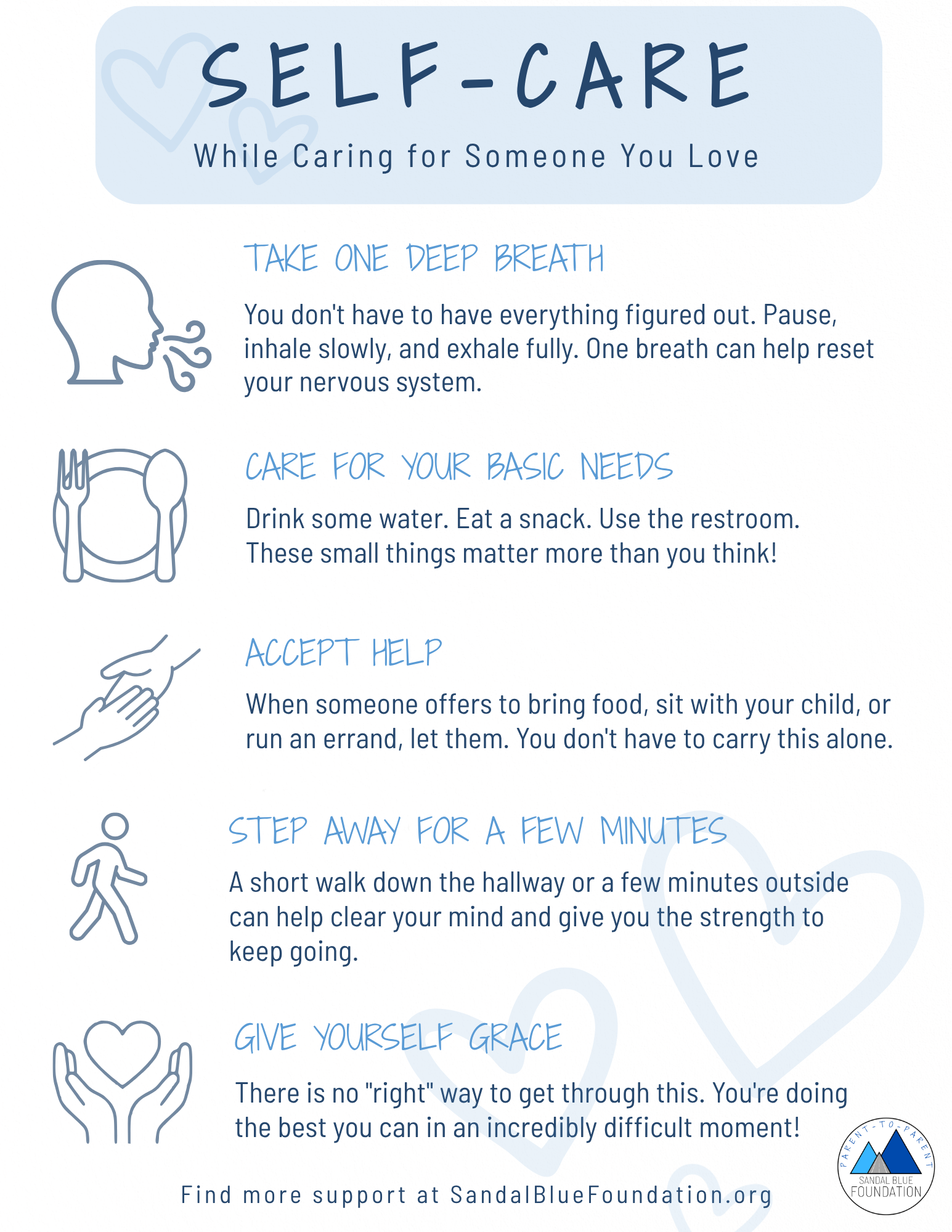
If leaving isn’t possible, simply changing rooms or finding a quiet moment can help reset your nervous system.

Caring for yourself isn’t a luxury—it’s what allows you to continue showing up.

Invite Help (and Think Outside the Box)

You are not meant to do this alone.

When people ask how they can help, it’s okay to give them real, tangible ways to step in. Sometimes that requires thinking creatively:

  • Have someone pick up and deliver groceries
  • Ask for help with school shopping for kids
  • Set laundry on the porch for someone to wash and return
  • Arrange for a cleaner to come help once survivors are home

Even small things—like providing paper products to reduce dishes—can make a meaningful difference.

Letting people help doesn’t make you less capable. It makes the load more sustainable.

Bring Moments of Joy Back In

In the middle of survival, it’s easy to lose sight of what feels normal or joyful.

Look for simple ways to bring that back:

  • Play music in the house
  • Dance in the kitchen
  • Do the things that once made your family smile

These moments won’t fix everything—but they can bring light into heavy days.

Even something like getting a haircut or doing a small “normal” activity can help restore a sense of self and emotional well-being.

Support the Whole Family

Caregiving isn’t just about the survivor—it’s about the entire family system.

Think about ways to ease the load for everyone:

  • Help children feel prepared with clothes or school supplies
  • Take care of tasks that often go unnoticed but add stress
  • Create small pockets of normalcy where you can

Every bit of support matters.

Managing the Long Road Ahead

Caregiving after trauma isn’t a short-term role for many—it’s a journey.

Managing stress is essential for the long haul:

  • Step outside when you can
  • Breathe deeply
  • Change your environment, even briefly

And remind yourself often: you don’t have to do everything.

A Final Reminder

This is hard.

There’s no way around that.

But there is also hope.
There is light at the end of the tunnel—even if you can’t see it yet.

People are more resilient than they realize. That includes the person you’re caring for, your family, and you.
Take it one day at a time.
Do what you can.
Let that be enough.

And most importantly—let people help.

Watch the full conversation as Tina shares simple, real life ways to navigate caregiving after trauma, including staying organized, asking for help, and taking care of yourself along the way.