Understanding Your Window of Tolerance After Trauma
There are moments after trauma when it feels like you are not reacting like yourself.
You are more irritable than usual.
More emotional.
More disconnected.
More exhausted.
More overwhelmed by things that once felt manageable.
And sometimes, the opposite happens.
You stop reacting altogether.
You scroll your phone for hours.
You feel numb.
You disconnect from people.
You move through the day checked out and unfocused, content to let life pass by because engaging with it feels too hard.
According to Keri Jones-Fonnesbeck, Executive Director of Trauma-Informed Utah, both of these experiences are part of being human — especially after trauma.
And understanding them begins with something called the Window of Tolerance.
What Is the Window of Tolerance?
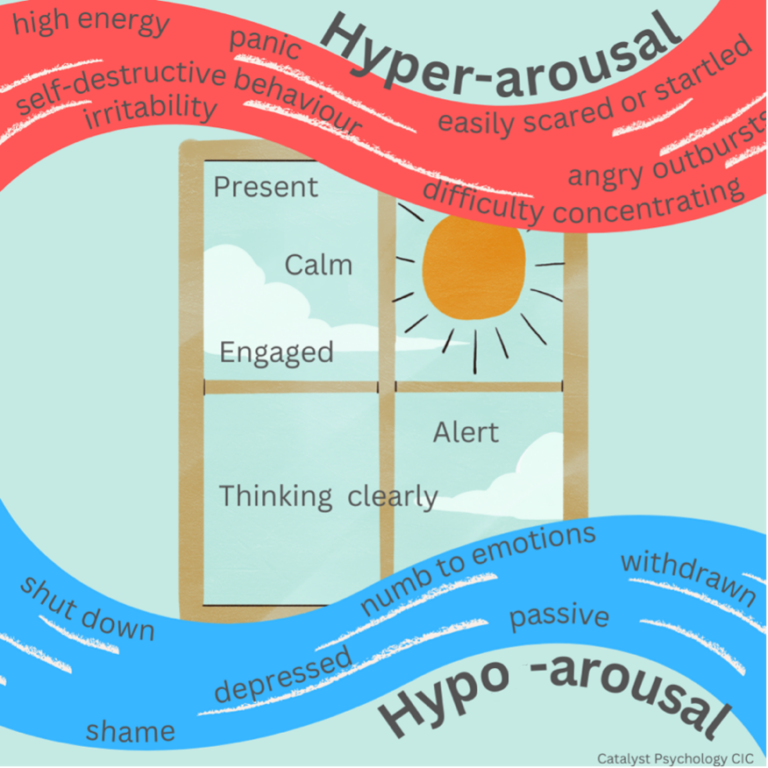
Keri describes the window of tolerance like looking through a clear window.
Inside the window, you are calm, connected, and present.
You can think clearly.
Regulate emotions.
Communicate effectively.
Engage in meaningful conversations.
Show up as your best self.
You have the clearest view of both yourself and the world around you.
But trauma impacts the brain and nervous system. It changes how we regulate emotions, connect with others, and respond to stress. Sometimes we get “kicked out” of that window.
And that is normal.
Not because you are failing.
Not because you are weak.
But because you are human.

Above the Window: Fight or Flight
Sometimes being outside the window looks loud.
Big emotions.
Frustration.
Anger.
Panic.
Overwhelm.
This is often the nervous system moving into fight or flight.
Sometimes it is triggered by something external — a loud noise, a stressful interaction, a smell, a memory, a feeling — something that reminds the brain of a time when we were not emotionally or physically safe.
Even when we consciously know we are okay, the body responds as though danger is present.
This is why self-awareness matters so much.
Recognizing:
- What emotions feel biggest for me?
- What situations tend to trigger them?
- What signs show up in my body before things escalate?
These are not questions about judgment.
They are questions about awareness.
Below the Window: Freeze and Shutdown
Other times, being outside the window looks quiet.
You feel numb.
Disconnected.
Unfocused.
Emotionally flat.
Checked out.
Keri explains this as the freeze response, or hypoactivation.
This can look like:
- Endless scrolling
- Avoiding decisions
- Feeling detached
- Not paying attention
- Losing motivation
- Feeling like you “don’t care”
When this happens, the goal is not shame.
The goal is noticing.
Because once we notice, we can begin gently supporting ourselves back toward regulation.
Your Window Can Shrink — and Expand
One of the most important reminders from Keri is that the window of tolerance is not fixed.
It is more like an accordion.
It can shrink during periods of stress, trauma, exhaustion, grief, illness, or overwhelm.
And it can expand with support, awareness, practice, and care.
The way we care for ourselves matters.
Have I eaten?
Hydrated?
Slept?
Moved my body?
Connected with someone safe?
How we show up for ourselves impacts how we show up for others.
Healthy people create healthy systems.
And trauma-informed care is about building that understanding into every system humans interact with — healthcare, schools, businesses, nonprofits, agencies, and communities.

Finding Your Way Back Into the Window
The goal is not to stay perfectly regulated all day.
None of us do.
We move in and out of our window constantly.
The key is learning:
- How to notice it
- How to respond
- How to return
Keri emphasizes that there is no one-size-fits-all solution.
The most important thing is finding what works for you.
Often, our senses are the pathway back.
The same senses that can trigger us can also help ground us.
Maybe it is:
- Ocean sounds
- Essential oils
- Deep breathing
- A drink of cold water
- Going on a walk
- Looking at pictures of people you love
- Calling someone safe
- Moving your body
- Squeezing your muscles to create blood flow
The goal is simple:
To remind your nervous system:
I am here.
I am safe.
I am well.
I am okay.
The 5-4-3-2-1 Grounding Exercise
One practical tool Keri shared is the 5-4-3-2-1 grounding exercise.
When you notice yourself outside your window, pause and identify:
- 5 things you can see
- 4 things you can touch
- 3 things you can hear
- 2 things you can taste
- 1 thing you can smell
Say them out loud if possible.
The purpose is not perfection.
It is presence.
It is bringing your awareness back into your body and into the current moment.

The “Take 5” Plan
Keri also encourages people to create a simple “Take 5” plan ahead of time.
Start with these questions:
- What emotions are most difficult for me?
- What situations tend to trigger those emotions?
- What signs tell me those emotions are starting to become too big?
Then create a list of five things you can do in five minutes that help calm and regulate your nervous system.
Examples might include:
- Looking at pictures of your kids
- Taking deep breaths
- Listening to ocean sounds
- Drinking a Diet Coke
- Calling someone you trust
Simple matters.
Small matters.
The point is not creating a perfect wellness plan.
The point is creating a realistic one.

Presence and Patience
Keri referenced the work of Kristen Neff and the idea that self-compassion requires action.
Not just acknowledging that things are hard.
But responding to yourself with care.
Asking:
- What do I need right now?
- What would help me feel supported?
- What would help me feel present?
And then practicing those things consistently.
Not perfectly.
Just consistently.
Because healing is a practice.
You Don’t Have to Do It Alone
One of the most powerful suggestions Keri shared was to involve another person.
Write down your answers.
Share your Take 5 plan with someone you trust.
Ask them to check in with you.
“This is something I’m trying for myself. Can you check in with me this week?”
Sometimes support looks incredibly simple.
And incredibly powerful.

A Reminder for Trauma Survivors
If you are struggling to stay regulated after trauma, it does not mean you are broken.
It means your nervous system has been through something significant.
Awareness matters.
Support matters.
Practice matters.
And so does patience with yourself.
As Keri shared during our conversation:
“You are a gift to you, and we’re so glad that you’re still here.”
Learn more about Trauma-Informed Utah at traumainformedutah.org.
Watch this incredible Resource Conversation with Keri Jones-Fonnesbeck from Trauma Informed Utah