Category: Grief and Loss

This category offers stories, strategies, and resources to help survivors and their families navigate the complex journey of loss. Focusing on processing emotions, finding support, and building resilience, it provides guidance and encouragement for moving forward while honoring what has been lost.
Families For Safe Streets
Grief and LossPost-Trauma LifeResource ConversationsYou Are Not Alone

Finding Support and Community After a Motor Vehicle Incident

A Conversation with Families for Safe Streets

After a motor vehicle incident, it can be difficult to know where to turn.
You may be dealing with physical injuries, grief, trauma, changes to your everyday life, complicated systems, or simply the feeling that no one around you really understands what you have been through.
And sometimes, you are not just trying to recover. You also want to make sure what happened to you does not happen to someone else.
That is where community can make an enormous difference.
In this Resource Conversation, Sandal Blue Foundation spoke with Aly Geller from Families for Safe Streets about the support available to people who have survived a crash, lost a loved one, or are caring for someone affected by a crash.
You Are Not Alone

Families for Safe Streets is a growing national organization with approximately 2,000 members and chapters across the country. The organization supports people whose lives have been affected by motor vehicle incidents while also working toward preventing future deaths and injuries.
Aly coordinates support services for the national organization. Her role includes helping new community members find the support, resources, and opportunities that fit where they are right now.
That last part is important.
There is no single “right” place to be after a traumatic event.
Maybe you are ready to connect with someone who understands. Maybe you need practical information about navigating what comes next. Maybe you want to talk with other survivors or people who have experienced a loss. Or maybe you are ready to use your experience to advocate for safer roads.
Families for Safe Streets has resources for all of those places.
As Aly shared, their team is ready to ask, “Where are you today?” and then help you find what you need right now.
The Power of Being Seen and Heard

One of the most meaningful parts of support after a motor vehicle incident can be talking with someone who truly understands.
There is something powerful about having a witness to your grief, physical pain, fear, frustration, or changing identity.
It can sound deceptively simple: being seen and heard.
But connecting with someone who has been through something similar can help reduce the isolation that often follows a traumatic experience.
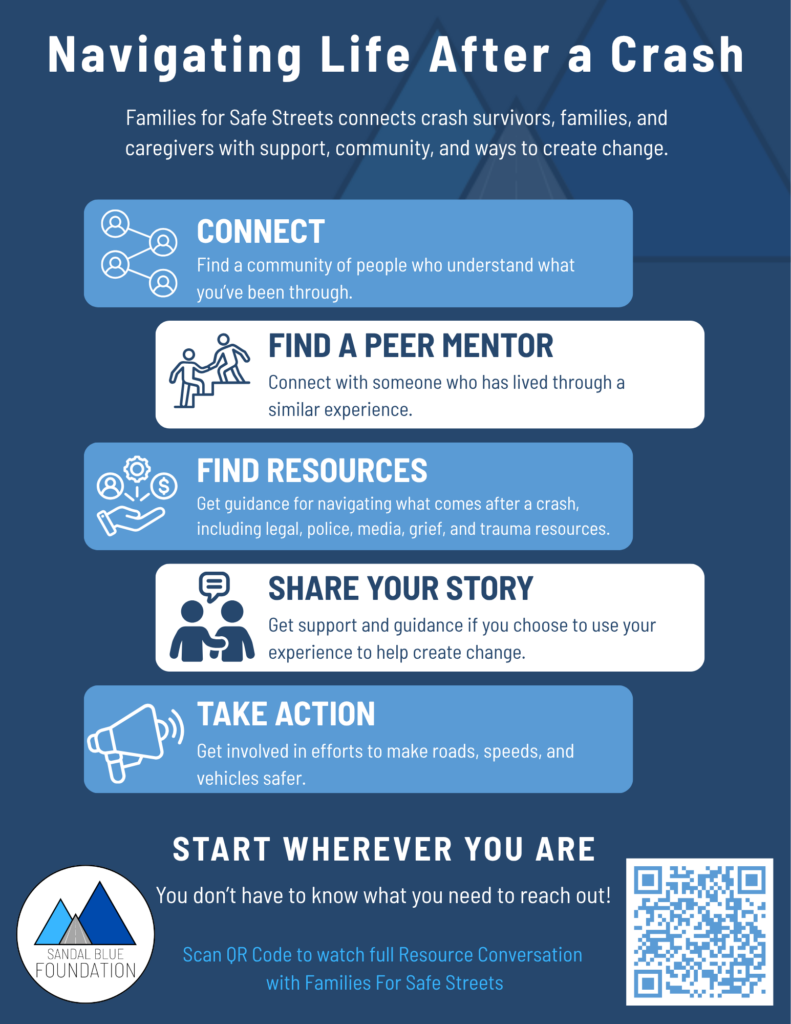
Families for Safe Streets offers a peer mentor program that connects community members with trained mentors who have their own experience with crash loss or injury. Mentors receive training in how to have supportive conversations, and whenever possible, people can be connected with someone whose experience is similar to their own.
Sometimes it also helps to meet someone who is a little farther down the road.
When you are in the middle of something incredibly difficult, seeing someone who has found a way forward can offer something important: a glimpse of possibility.
There can be a light at the end of the tunnel.
Support Does Not Have to Be One-on-One

Not everyone wants individual support, and sometimes it helps to be part of a larger community.
Families for Safe Streets offers virtual support gatherings where people affected by crashes can come together, connect, and participate in facilitated conversations.
The organization also hosts special events, including book clubs and guest speakers, giving members opportunities to learn, connect, and build relationships with others who understand.
There is also a National Story Map, an online space created to honor and memorialize people who have been killed in crashes.
The Story Map gives families and survivors a place to be seen and heard. It also allows decision-makers and the broader community to see the human beings behind crash statistics.
Because these are not just numbers.
They are people.
They are parents, children, spouses, siblings, friends, coworkers, and neighbors whose lives have been changed.
Practical Resources for the Road Ahead

Support after a motor vehicle incident is not only emotional.
Sometimes you need to know what to do next.
Families for Safe Streets has a Post-Crash Resource Guide designed to help people navigate some of the systems and situations that can come after a crash, including interacting with law enforcement, navigating the legal system, and responding if the media reaches out.
They also have a member-generated Resource Guide with resources related to grief, trauma, and other needs that can arise after a crash.
These resources are designed to be something you can return to when you are ready.
You do not have to figure everything out at once.
Turning Experience Into Change

For many people affected by crashes, there eventually comes a point when they want to do something to prevent others from experiencing what they have experienced.
Families for Safe Streets creates opportunities for people to do exactly that.
The organization focuses on upstream solutions: evidence-based approaches that address the conditions that contribute to crashes before someone is injured or killed.
Their advocacy work includes safer roads, safer speeds, and safer vehicles.
One current campaign is Stop Super Speeders, which advocates for legislation requiring intelligent speed assistance devices for repeat speeding offenders. The campaign has passed in nine states or jurisdictions and continues to grow.
Families for Safe Streets also has an Ambassador program that provides training for people who want to become involved in advocacy and learn how to help advance this type of legislation in their own state.
You can explore the Stop Super Speeders campaign, see where legislation has passed or is pending, and learn how to get involved.

Why Stories Matter

Story sharing is at the heart of much of Families for Safe Streets’ advocacy work.
Research shows that stories can make information more memorable and can influence decision-makers. But Aly also recognizes something equally important:
Sharing your story can be empowering, and it can also be incredibly difficult.
That is why Families for Safe Streets does not simply ask people to tell their stories and send them on their way.
They work to create a foundation of support around the process.
Aly provides one-on-one guidance from the time someone joins the organization and throughout their involvement. The organization also provides training and support to help people understand how to share their experiences in ways that feel appropriate for them.
You get to decide what you share, when you share it, and how you participate.
You Can Start Wherever You Are

If you are interested in connecting with Families for Safe Streets, you do not have to know exactly what you need before you reach out.
One of the easiest places to start is by becoming a member.
Once you join, you can be connected with a local chapter when one is available in your area. Chapters are supported by sponsor organizations and provide opportunities for community gatherings, programs, advocacy, and connection.
You can also:
And if you do not see exactly what you need, you can reach out directly. Their team can help you figure out what might be a good next step.
World Day of Remembrance for Road Traffic Victims

Families for Safe Streets is also a co-planner of World Day of Remembrance for Road Traffic Victims in the United States, a national event taking place in communities across the country on the third Sunday in November.
The event provides an opportunity to remember those who have been killed or injured in road traffic incidents and to call attention to the need for safer roads and transportation systems.
The World Day of Remembrance website includes resources for people who want to attend an event or organize one in their own community.

You Can Be Supported While You Make Change

One of the things that stood out in our conversation with Aly is that support and advocacy do not have to be separate.
You can be grieving and still want change.
You can be healing and still want to help others.
You can be overwhelmed and still take one small step.
And you do not have to do any of it alone.
Families for Safe Streets exists to walk alongside people affected by crashes, whether that means helping you find a peer mentor, connecting you with resources, giving you a place to share your story, or helping you find a way to turn your experience into action.
As Aly shared, you are not alone.
It may feel that way sometimes, but there is a powerful community of people who understand and are ready to hold and guide you.
Watch the full Resource Conversation to learn more about Families for Safe Streets.
Talk Therapy
Grief and LossPost-Trauma LifeResource ConversationsSupport and Caregiving

How Talk Therapy Can Support Healing After a Motor Vehicle Incident

After a motor vehicle incident, it’s common to feel like your mind and emotions are working against you. You may replay the crash over and over, feel disconnected from yourself, or wonder if what you’re experiencing is “normal.”

For this Resource Conversation, we sat down with Ben Rhinesmith, a licensed Marriage and Family Therapist from Desert Oasis Therapy, to talk about what therapy actually looks like, why it can be so helpful after trauma, and some practical ways to navigate the healing process.

Here are some of the biggest takeaways from our conversation.

Talk therapy is much more than talking to a friend

Many people hesitate to try therapy because they think it’s simply sitting in a room and talking about their problems. While conversation is certainly part of it, therapy is much more intentional.

Therapists use evidence-based approaches to help people understand their experiences, develop healthier emotional and relational habits, and make meaningful changes in their lives.

Ben explained that he often looks at people through several different therapeutic lenses, including:

  • Systems theory, which explores how the relationships and environments around us influence healing.
  • Narrative therapy, which helps people examine the stories they’ve developed about themselves and discover ways to rewrite those stories.
  • Solution-focused therapy, which builds on a person’s existing strengths instead of only focusing on what’s wrong.

The goal isn’t simply to talk about what happened – it’s to help you move toward the life you want.

Therapy doesn’t have to feel heavy all the time

Many people assume therapy is emotionally exhausting every single session.

Ben challenged that idea.

While difficult conversations certainly happen, therapy can also be empowering, encouraging, and even enjoyable. Celebrating progress, recognizing strengths, and finding hope are just as important as processing pain.

Healing isn’t only about surviving difficult moments—it’s also about learning how to experience joy again.

“Is what I’m feeling normal?”

One of the most common questions survivors ask is whether their reactions after a traumatic event are normal.

Ben introduced the idea of common humanity – the understanding that many of the emotional responses following trauma are shared experiences.

After a motor vehicle incident, your entire perception of the world may change. Things that once felt safe may suddenly feel threatening.

Rather than expecting yourself to immediately “get over it,” Ben encourages people to remember that healing comes in waves.

There will be good days. There will be hard days.

The overall direction can still be forward.

Be patient with yourself. Be compassionate with yourself. Healing is rarely a straight line.

Your thoughts are not always the truth

Trauma often brings an overwhelming number of thoughts.

Some are helpful. Some are frightening. Some simply aren’t true.

Ben encourages people not to label thoughts as “good” or “bad.” Having a thought doesn’t mean it’s a fact. If you misspeak, it doesn’t mean you’re unintelligent. If you feel afraid, it doesn’t mean you’re unsafe. Sometimes it simply means your brain is processing something incredibly difficult.

He shared a helpful way to think about it.

Our brains have a fast pathway designed for survival. Imagine seeing a tiger at a watering hole. Your brain immediately says, “Run!” But then a slower pathway kicks in. You realize you’re actually watching the tiger from inside a jeep. The danger wasn’t what it first appeared to be.

After trauma, our first thoughts are often protective – not necessarily accurate.

Sometimes we need to wait for the second, third, or fourth thought before we arrive at the one that truly reflects reality.

When grief feels like it takes over everything

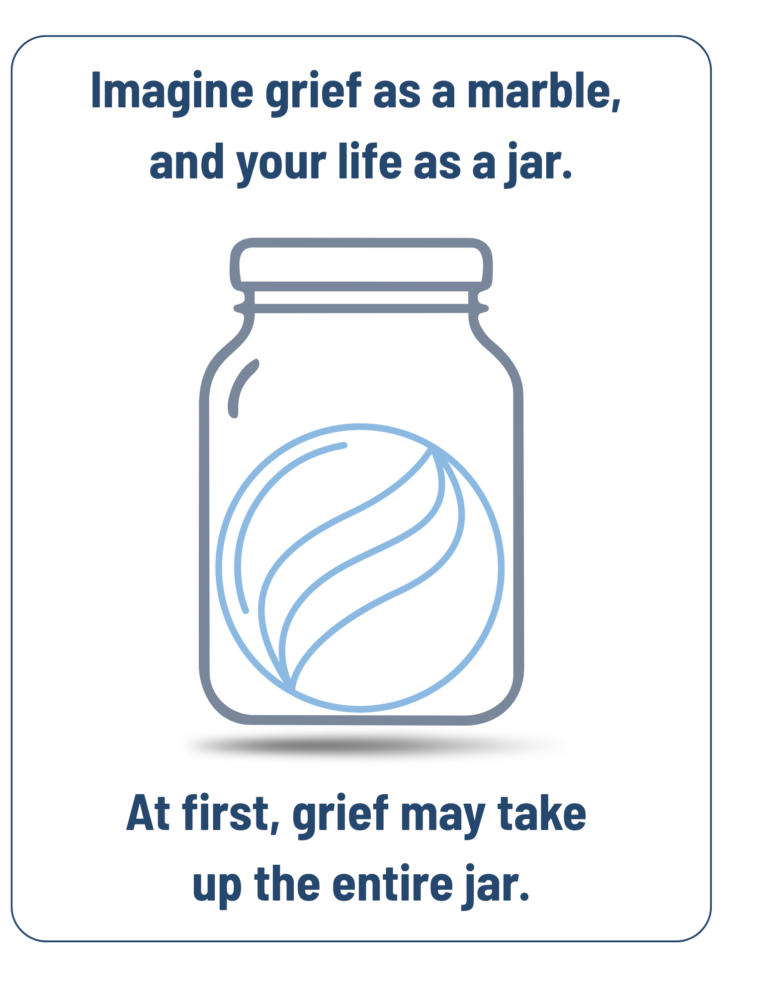
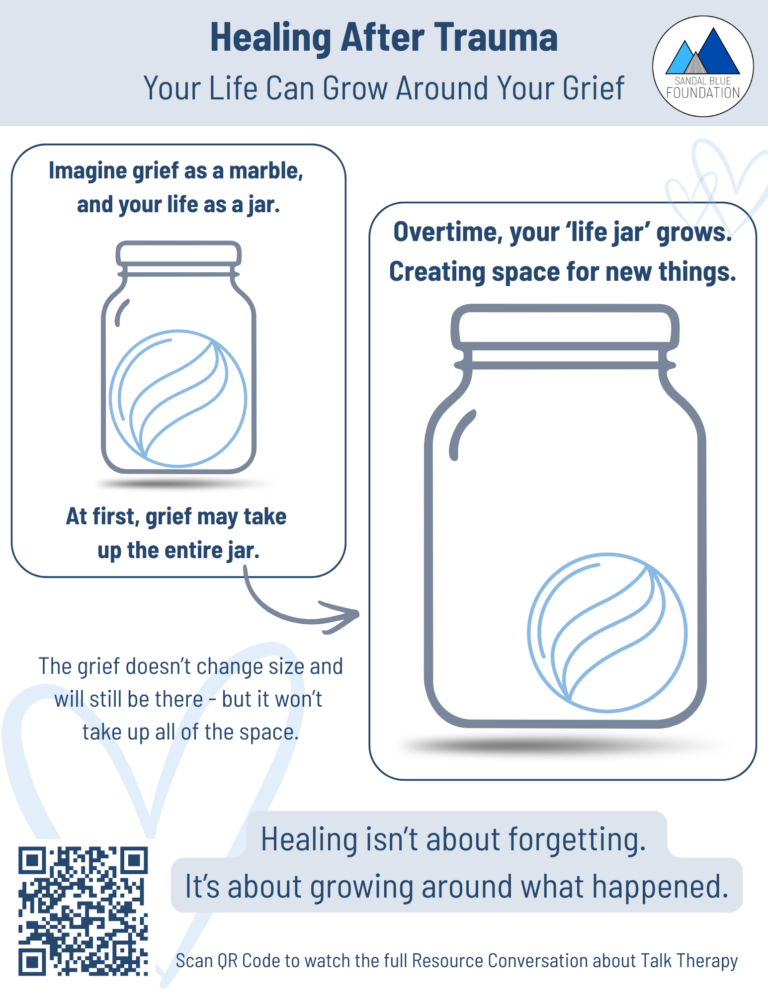
One of Ben’s favorite ways to explain grief is through the image of a jar.

At first, grief feels like it fills your entire life.

Every thought. Every conversation. Every moment.

Over time, something beautiful happens.

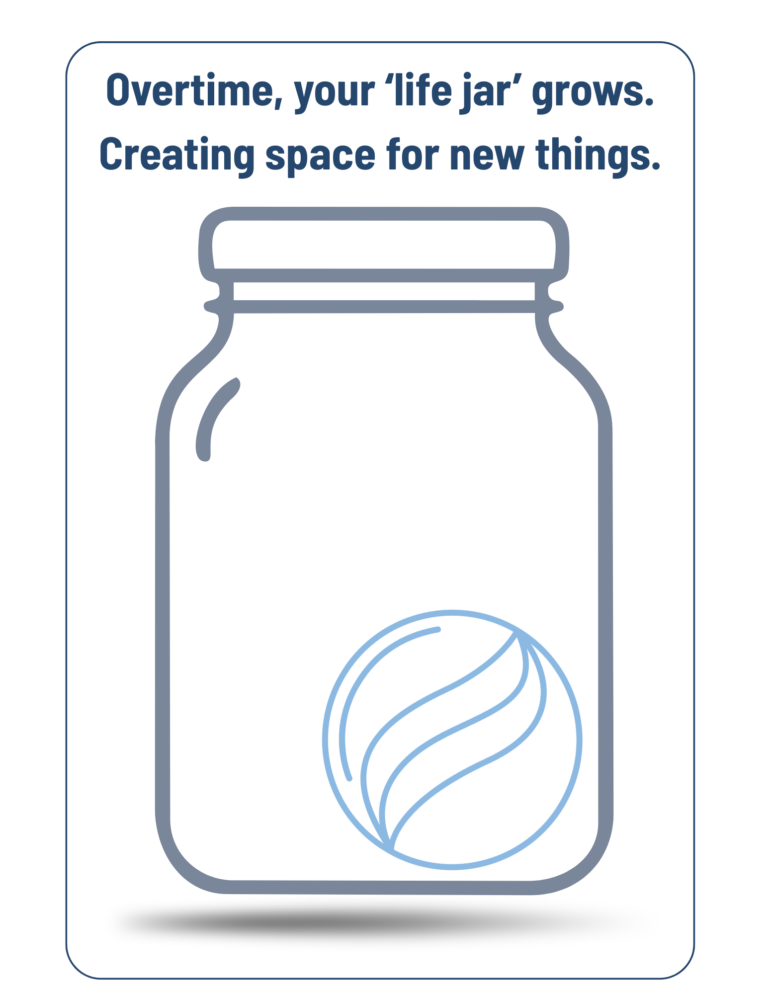
The grief doesn’t necessarily get smaller—but your life gets bigger.

Imagine your grief as a marble inside a jar. The marble stays the same size. But the jar continues to grow. As your life expands, there becomes room for friendships, laughter, purpose, hobbies, hope, and new experiences alongside the grief.

The grief is still there. And you are still growing.

Both can exist together.

Look for glimmers, not just triggers

Many survivors become familiar with the idea of triggers – places, sounds, or situations that bring difficult emotions back to the surface.

Ben encourages people to also begin looking for glimmers.

Glimmers are small moments that remind your nervous system that life can still contain goodness.

Watching a sunset. Playing a board game. Going to a movie. Laughing with someone you love. Enjoying a favorite meal. These moments don’t erase the pain. They don’t disrespect what happened.

Instead, they remind us that hope still exists.

Healing isn’t choosing between hard moments and beautiful moments. It’s learning to hold space for both.

Every family member heals differently

When an entire family experiences a traumatic event, everyone creates their own story about what happened.

Each person processes grief differently.

Each person moves through emotions differently.

Each person heals on their own timeline.

No stage is better than another.

No timeline is “correct.”

Giving yourself – and your loved ones – the freedom to heal differently can reduce frustration and increase compassion within the family.


Grief is more than the loss of life

We often associate grief with death, but grief is the loss of anything meaningful.

After a motor vehicle incident, people may grieve:

  • Their health
  • Their independence
  • Their sense of safety
  • Their identity
  • Their routines
  • Their future plans

Recognizing these losses helps us understand why healing takes time.

Keep looking until you find the right support

Ben ended our conversation with an encouraging reminder.

You were never meant to go through trauma alone.

Finding the right therapist – or even the right type of therapy – sometimes takes time.

If one therapist isn’t the right fit, don’t give up. If one approach doesn’t connect with you, keep looking. There are people who want to help. There are therapists who care deeply about your healing.

Keep reaching out until you find the support that feels right for you.

Watch the full conversation

Remember: healing isn’t about leaving your trauma behind. It’s about growing a life that’s big enough to hold both the hard and the beautiful.